
SF Anti-Aging Treatments: Peels, Microneedling, IPL ($275+)
Compare microneedling, chemical peels & IPL for anti-aging in SF: prices from $275, sessions and downtime from published sources, near Union Square.
Short answer: match the treatment to the concern. Microneedling is aimed at fine lines, wrinkles, acne scars and texture; a chemical peel at dullness, uneven tone and fine lines; an IPL photofacial at brown spots and visible redness or small blood vessels. At Aesthetic OOGII in downtown San Francisco, microneedling with skin growth factors, a chemical peel and the IPL photofacial are each $300 a session, and a Clinical Anti Aging Treatment is $275. Recovery ranges from the published sources are compared below.
Professional Treatments and Your At-Home Routine
A good home routine is not a lesser version of a clinic treatment; the two do different jobs. The American Academy of Dermatology (AAD) says a retinoid "spurs faster turnover of surface skin cells and boosts collagen" and "improves skin tone and reduces fine lines and wrinkles." Retinol is sold in over-the-counter products, and the AAD notes that adapalene comes in both prescription and over-the-counter formulations, while tretinoin, tazarotene and trifarotene are available by prescription. The AAD also advises starting with the least intense formula every other night and building up slowly, and says people with darker skin should be careful, because "irritation can trigger dark marks, known as hyperpigmentation."
In-clinic treatments work by a different route. Microneedling uses thin needles to make tiny holes in the top layer of the skin, a chemical peel applies a chemical solution that removes outer layers of skin, and IPL delivers broad-spectrum light that is absorbed by targets in the skin such as melanin and hemoglobin. Each carries its own recovery time and risks, so the useful question is not "clinic or cream" but which clinic treatment fits your concern, your skin type and the downtime you can accept, alongside the sunscreen and home care you keep using.
Who can perform each treatment also matters. In California, the Board of Barbering and Cosmetology's regulations limit what an esthetician license covers; for example, they allow removal of only the upper layer of the skin, the epidermis (16 CCR §992). Whatever clinic you choose, ask who will perform your treatment and under which license.
Microneedling (Collagen Induction Therapy): Texture, Scars and Fine Lines
The U.S. Food and Drug Administration (FDA) describes microneedling devices as instruments with many small needles, tips or pins that are repeatedly inserted into and removed from the skin. The FDA has authorized such devices to improve the appearance of facial acne scars, facial wrinkles and abdominal scars in patients aged 22 or older.
Because the tiny punctures prompt the skin to make new collagen, the AAD notes that microneedling is "also called 'collagen induction therapy,'" so if you are searching for collagen induction therapy in San Francisco, this is the treatment. The AAD lists wrinkles and fine lines, sagging skin, uneven texture and tone, and acne scars among the concerns dermatologists use it for.
Cleveland Clinic explains that microneedling stimulates collagen and elastin, and lists enlarged pores, fine lines and wrinkles, acne scars, discoloration and stretch marks among the concerns it is used for. It gives these expectations:
- Recovery: skin can be red and swollen for up to five days.
- Spacing: sessions are spaced three to eight weeks apart.
- Results: improvement appears over three to six months.
- Caution: talk to your provider first if you have active acne or take acne medication, have a blood disorder or take blood thinners, form keloid scars, or have eczema or psoriasis.
The FDA lists redness, bruising, bleeding, discomfort and peeling as common side effects, and pigmentation changes, infection and herpes (cold-sore) reactivation as less common ones, adding that "some side effects may be permanent." Microneedling does not use heat or light, but that does not make it free of pigment risk.
At Aesthetic OOGII: Microneedle Treatments with skin growth Factors is $300 for a 60-minute session, or $700 for a three-session package. See the microneedling page for details. The studio is at 450 Sutter St, Suite 1530, in downtown San Francisco.
Chemical Peels: Tone, Texture and Dullness
A chemical peel applies a chemical solution that removes outer layers of skin. Cleveland Clinic names glycolic acid, trichloroacetic acid (TCA), salicylic acid, lactic acid and phenol among the agents used, and says light peels suit fine wrinkles and acne, with recovery measured in hours to a few days. Peels are grouped by depth rather than by a single acid or percentage, and the AAD gives these healing times:
- Refreshing ("lunchtime") peel: 1 to 7 days; skin will be red.
- Medium peel: 7 to 14 days; skin will be red and swollen.
- Deep peel: 14 to 21 days; the area will be bandaged, and the AAD says it must be performed in a surgical setting under general anesthesia. Cleveland Clinic calls a deep peel on the face a one-time-only treatment.
For lighter peels, the AAD says they "may be repeated every 2 to 5 weeks" and that 3 to 5 peels may be necessary. It also warns that without the right expertise, people with skin of color "can develop permanent pigment problems," and suggests seeing a dermatologist experienced with peels on darker skin. Cleveland Clinic advises against a peel if you have a history of abnormal scarring or cannot stay out of the sun while healing.
At Aesthetic OOGII: a chemical peel is $300 for a 60-minute session, or $600 for three. The chemical peel page covers what the treatment involves there.
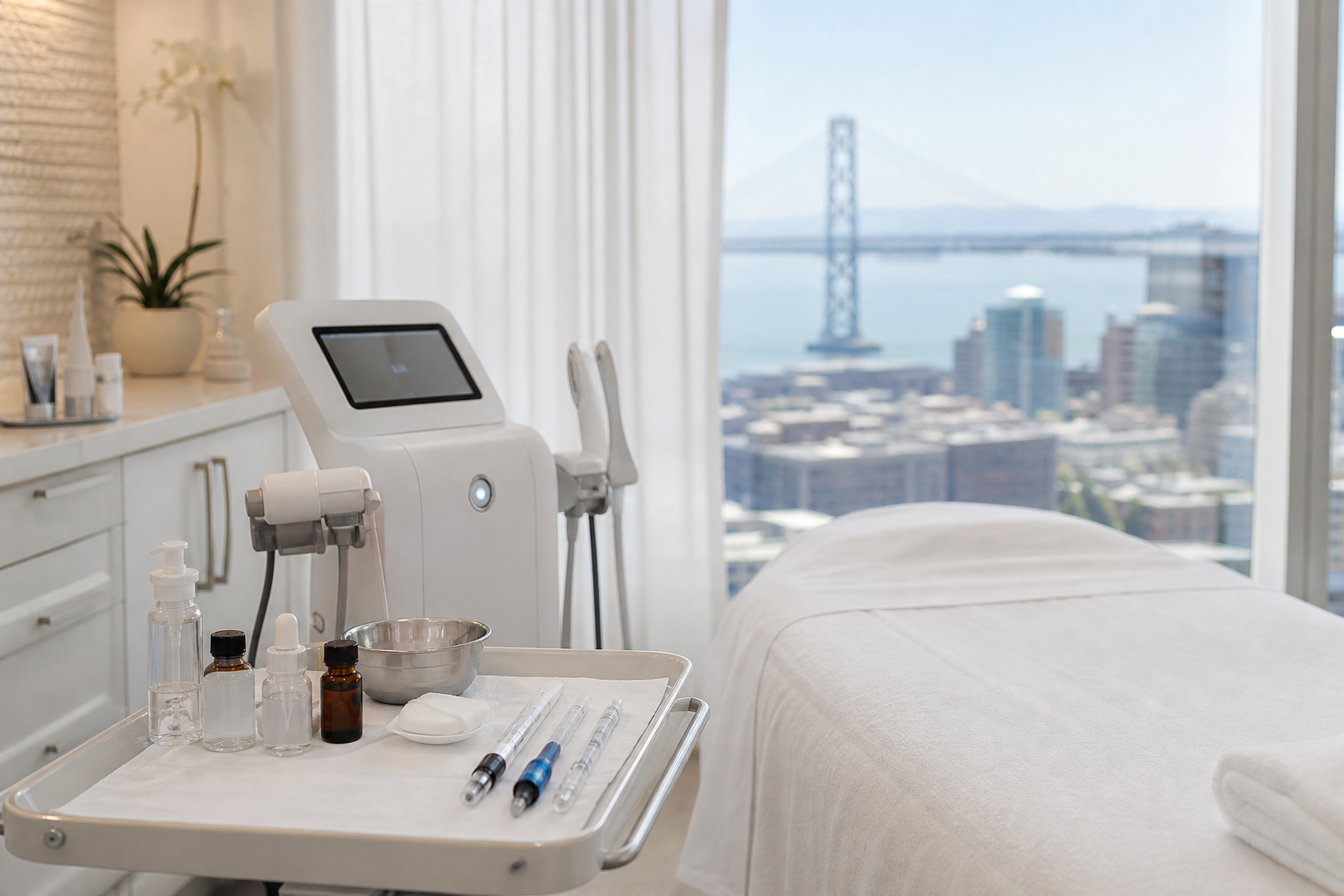
Illustration only; not a photo of Aesthetic OOGII's studio.
IPL Photofacial: Brown Spots, Redness and Visible Vessels
IPL (intense pulsed light) uses a flashlamp to deliver broad-spectrum light, usually in the 500 to 1,200 nm range, which is absorbed by melanin, hemoglobin and water in the skin (JCAD review). UT Southwestern Medical Center lists age spots, brown spots, freckles, broken blood vessels, rosacea redness, fine wrinkles and acne scars among the concerns it is used for. Its description of the process:
- It "may cause a slight stinging sensation similar to a rubber band snapping against the skin."
- "Pigmented areas may darken initially before they flake off over the next few days."
- "Most patients can return to their normal activities, including work, on the same day."
- UT Southwestern says most patients need five to six sessions spaced about two to four weeks apart; Healthline says three to six treatments, spaced about one month apart.
IPL needs screening. UT Southwestern says people with an active infection, a recent tan, pregnancy, or use of certain medications such as isotretinoin should avoid it, and that people with Fitzpatrick skin types IV to VI or with melasma may not be good candidates. It advises avoiding the sun and using SPF 30 or higher during recovery. For rosacea, the AAD reports on laser and light therapy in general (it does not single out IPL): most patients see a 50% to 75% reduction in visible blood vessels after 1 to 3 treatments, but for permanent facial redness most had about a 20% reduction, and "your results depend largely on the person performing your treatment."
At Aesthetic OOGII: the IPL photofacial is $300 for a 75-minute appointment, or $650 for three. More on the IPL photofacial page.
Growth Factors: What the Evidence Shows
Growth-factor serums are skincare products that contain signaling proteins. A 2023 systematic review in the Journal of Cosmetic Dermatology looked at 33 studies (9 randomized controlled trials) of 23 different topical growth-factor preparations, mostly applied twice daily for about three months. Based on investigator assessment, the improvement was modest (median under 50% for texture and under 35% for fine lines and wrinkles versus baseline), the studies varied widely in what they tested and how they measured it, and "the persistence of the clinical improvements beyond 6 months is not known." The review found a low risk of adverse events.
Growth factors are also applied during microneedling. The FDA notes that "microneedling devices are not approved for delivery of cosmetics, topical medications, drugs, or blood products (for example, platelet-rich plasma (PRP)) into the skin." In other words, the serum is an add-on, and the device clearance does not cover it.
At Aesthetic OOGII: growth factors are not sold as a standalone facial, and PRP is not on the menu. They are part of the Microneedle Treatment with skin growth Factors ($300, 60 minutes). For a treatment without needling, the menu lists a Clinical Anti Aging Treatment ($275, 75 minutes; $600 for three, $995 for six), which the menu describes as suitable for all skin types and requiring no downtime, and a HydraFacial & Collagen Treatment ($325, 75 minutes). What growth factors add to microneedling covers this in more depth.
Choosing Between Them
A simple way to narrow the choice is to start from the concern, then check recovery and suitability:
- Acne scars, fine lines, texture: microneedling, whose FDA-authorized uses include facial acne scars and facial wrinkles; expect redness and swelling for up to five days (Cleveland Clinic).
- Dullness, mild discoloration, rough texture: a light peel, with 1 to 7 days of healing (AAD).
- Brown spots, visible vessels, rosacea redness: IPL, usually as a series; ask whether your skin type is a good candidate (UT Southwestern).
- No downtime wanted: the menu describes the Clinical Anti Aging Treatment ($275) as requiring no downtime; ask at your consultation whether it fits your concern.
If you want more than one treatment, how to space them depends on your skin and the specific treatments, so plan the order and gaps with the person treating you rather than following a generic calendar. Tell them about medications (including retinoids and isotretinoin), recent sun exposure, cold-sore history and any past reactions.
Illustrative photo.
Your First Visit
Aesthetic OOGII's policy page says: "Every client is offered a complimentary consultation with Oogii. Our consultations include an assessment about your skin to recommend best course for treatment." Oogii is a certified medical and clinical aesthetician and the owner of the practice at 450 Sutter St, Suite 1530. The menu also has a Skin Analysis/Deep Cleansing session ($175, 60 minutes); read what to expect from a first skin analysis.
Questions worth asking at any consultation:
- Which concern is this treatment meant to address, and how many sessions do you suggest for me?
- What will my skin look like during recovery, and when can I wear makeup?
- Is my skin type a good candidate, and what are the pigment risks for me?
- Who performs the treatment, and under which license?
- Which of my current products should I pause before and after?
The policy page also asks clients to mention health conditions, allergies and recent procedures when booking, and notes that packages are non-refundable and must be redeemed within a calendar year.
FAQ: Anti-Aging Treatments in San Francisco
What is the best treatment for aging skin?
There is no single best treatment. Microneedling devices are FDA-authorized to improve the appearance of facial acne scars and facial wrinkles; light chemical peels are used for fine wrinkles, dullness and uneven tone; IPL targets brown spots and visible blood vessels. The right choice depends on your concern, your skin type and how much recovery time you can accept.
How much downtime does each treatment need?
Cleveland Clinic says microneedled skin can be red and swollen for up to five days. The AAD gives 1 to 7 days of healing for a light peel and 7 to 14 days for a medium peel. UT Southwestern says most IPL patients return to normal activities, including work, the same day, though treated spots may darken before flaking off.
Are these treatments safe for darker skin tones?
All three carry pigment risk that needs individual screening. The FDA lists pigmentation changes among microneedling risks, the AAD warns that people with skin of color can develop permanent pigment problems from peels without the right expertise, and UT Southwestern says Fitzpatrick skin types IV to VI may not be good IPL candidates.
Do growth-factor serums work?
A 2023 systematic review found modest improvements in texture and fine lines with topical growth-factor products, with a low risk of adverse events, but the studies varied widely and it is not known whether improvements last beyond six months. The FDA says microneedling devices are not approved for delivering such products into the skin.
How much do these treatments cost at Aesthetic OOGII?
Microneedling with skin growth factors is $300 (60 minutes) or $700 for three; a chemical peel is $300 (60 minutes) or $600 for three; the IPL photofacial is $300 (75 minutes) or $650 for three; the Clinical Anti Aging Treatment is $275 (75 minutes).
Can I use retinol alongside clinic treatments?
The AAD says retinoids boost collagen and reduce fine lines, but advises starting slowly because they can irritate skin, and UT Southwestern lists isotretinoin among the medications that rule out IPL. Tell your provider which retinoids you use so they can tell you when to pause them around a treatment.
About the author
Oogii
Certified Medical & Clinical Aesthetician, Aesthetic OOGII
Certified medical and clinical aesthetician, owner of Aesthetic OOGII, a clinical skincare and medical aesthetics practice at 450 Sutter St in downtown San Francisco.