
Dermaplaning San Francisco: Results, Cost & What to Expect
Manual exfoliation that removes dead skin and peach fuzz for smoother, brighter skin. Cost, results, downtime, and what to expect during treatment.
What Is Dermaplaning and How Does It Work
Dermaplaning is a manual exfoliation technique that uses a sterile surgical scalpel to gently scrape off the top layer of dead skin cells and vellus hair (peach fuzz) from your face. The blade is held at a 45-degree angle and stroked across your skin in short, feathering motions. It sounds intense, but when done by a trained esthetician, it's painless and leaves your skin immediately smoother and brighter.
The treatment targets the outermost layer of your epidermis—the stratum corneum—where dead skin cells accumulate and make your complexion look dull. By removing that buildup, dermaplaning reveals the fresh, healthy skin underneath. It also eliminates the fine vellus hair that can trap oil and dirt, giving your face a cleaner, more refined appearance.
Unlike chemical exfoliants that dissolve dead skin or mechanical scrubs that buff it away, dermaplaning physically shaves off the entire surface layer in one pass. That precision makes it more thorough than other exfoliation methods, and it doesn't cause the irritation or redness that acids and scrubs can trigger in sensitive skin types.
The procedure takes about 30-45 minutes for the full face. There's no downtime—your skin might look slightly pink for an hour or two, but you can wear makeup and go about your day immediately afterward. Most people schedule dermaplaning every 3-4 weeks to maintain the smooth texture and glow, since that's how long it takes for new dead skin and peach fuzz to accumulate.
Who Should Get Dermaplaning (and Who Shouldn't)
Dermaplaning works best for people with dull, textured skin who want immediate smoothness and brightness. If you've noticed that your makeup sits unevenly on your face, or your skincare products aren't absorbing the way they used to, dead skin buildup is likely the culprit. Dermaplaning clears that layer away so serums, moisturizers, and foundations perform better.
It's especially good for people who can't tolerate chemical exfoliants. If glycolic acid, salicylic acid, or retinol irritates your skin, dermaplaning gives you the same exfoliation benefits without the stinging or peeling. It's also safe for pregnant or breastfeeding clients, since it's entirely mechanical with no chemicals involved.
People with fine facial hair often love dermaplaning because it removes the peach fuzz that can make skin look fuzzy or trap makeup. Without that layer of vellus hair, your face reflects light more evenly and looks smoother in photos. The hair grows back at the same rate and texture—dermaplaning doesn't make it thicker or darker, despite the myth. You're cutting the hair at the surface, not affecting the follicle underneath.
That said, dermaplaning isn't for everyone. If you have active acne, especially inflamed cystic breakouts, the blade can spread bacteria and make things worse. Rosacea or very thin, reactive skin can also flare up from the physical exfoliation. And if you have active cold sores or open wounds, you'll need to wait until they're healed. A skilled esthetician will evaluate your skin during consultation and recommend an alternative if dermaplaning isn't the right fit.
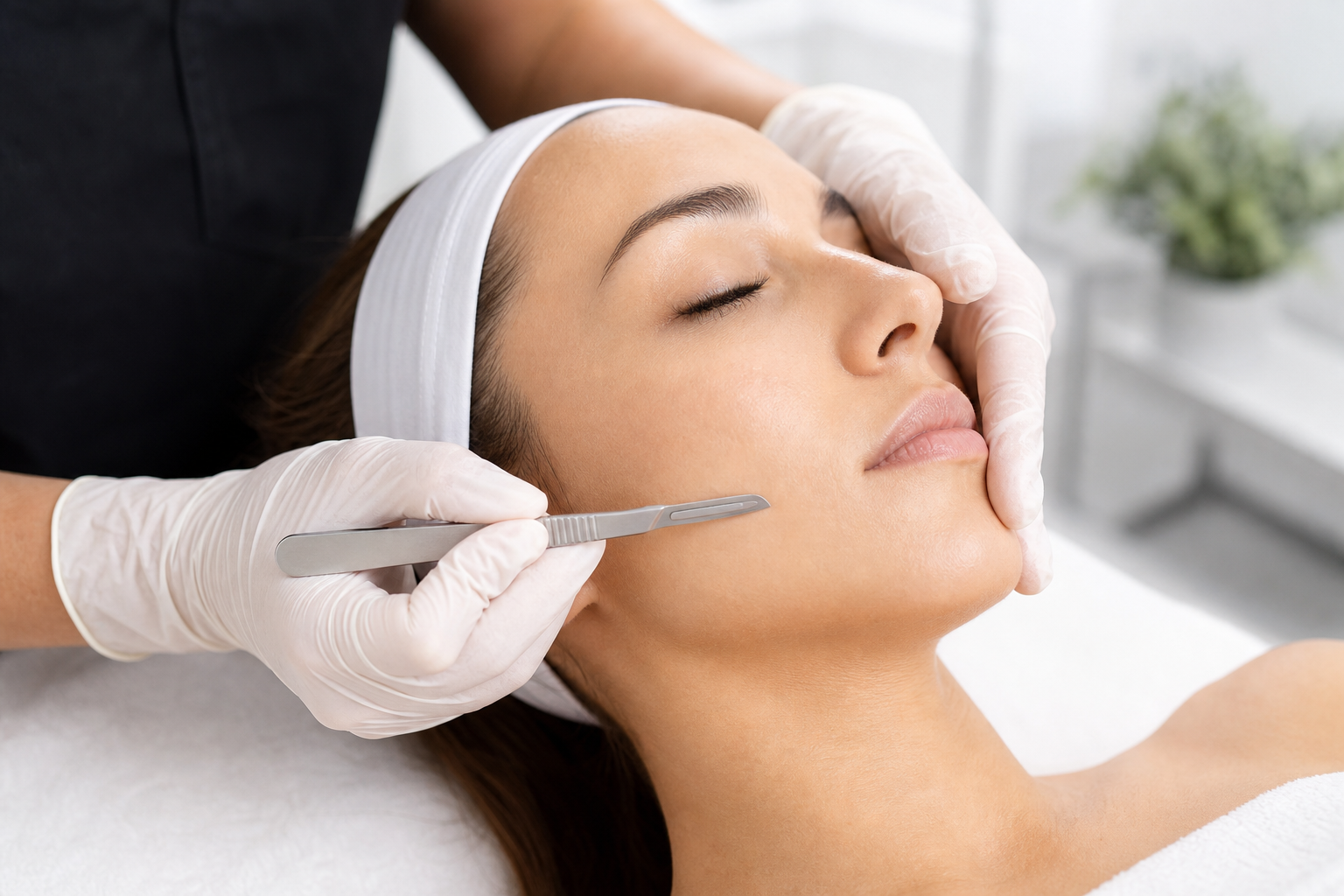
The blade is held at a precise 45-degree angle to safely exfoliate without cutting the skin.
What Happens During a Dermaplaning Session
Your appointment starts with a double cleanse to remove makeup, oil, and surface dirt. The esthetician needs a completely clean canvas to work on—any residue left on your skin could cause the blade to skip or drag. After cleansing, they'll prep your skin with a toner or degreaser to remove any remaining oils that might interfere with the blade's glide.
Once your skin is prepped, the esthetician will pull it taut with one hand and use the scalpel with the other. They'll start in one area—usually the forehead or cheeks—and work in short, overlapping strokes. You'll hear a light scraping sound as the blade moves across your skin, and you might feel a gentle tugging sensation, but it shouldn't hurt. If you feel sharp pain or cutting, speak up immediately—that's not normal.
The entire face takes about 20-30 minutes to dermaplane. The esthetician will work systematically across your forehead, cheeks, chin, jawline, and upper lip, avoiding delicate areas like your eyelids and the skin directly around your eyes. Some practitioners also dermaplane the neck if you request it, though that's usually an add-on.
After dermaplaning is complete, most estheticians apply a hydrating serum or calming mask. Your skin is ultra-receptive at this point—without the dead skin barrier, products penetrate much deeper. If your session includes a mask, it'll sit for 10-15 minutes while your skin absorbs the active ingredients. The appointment wraps up with moisturizer and SPF, and you're good to go. Total session time is usually 30-45 minutes depending on whether you add any extras like LED light therapy or a hydrating treatment.
Dermaplaning Results: What You'll See and Feel
The results are immediate. As soon as you look in the mirror after treatment, you'll see smoother, brighter skin. Your complexion looks more even, and if you had visible peach fuzz before, it's completely gone. Your face will feel softer to the touch—like you just polished away a layer of roughness.
Makeup application improves dramatically. Foundation and powder glide on without catching on dry patches or settling into fine lines. If you've been dealing with makeup that looks cakey or uneven, dermaplaning fixes that by creating a smooth base. Many people find they need less foundation after treatment because their natural skin tone looks more uniform.
Your skincare products also work better. Serums, moisturizers, and treatments absorb faster and penetrate deeper without a layer of dead skin blocking them. If you use vitamin C, hyaluronic acid, or retinol, you'll notice they feel more effective in the week following dermaplaning. That's why many people schedule the treatment right before starting a new product—they want maximum absorption.
The glow lasts about 2-3 weeks before you start to notice your skin looking duller again. Dead skin cells naturally regenerate every 28 days, and vellus hair grows back at its normal rate, so the effects aren't permanent. Most clients at our Union Square studio book dermaplaning every 3-4 weeks to maintain that fresh, polished look.
There's minimal downtime. Your skin might be slightly pink for an hour or two, and it could feel tight or sensitive for the rest of the day. Some people experience minor breakouts 2-3 days post-treatment as impurities surface, but that clears quickly. Avoid direct sun exposure for 48 hours and wear SPF 30+ daily—your newly exfoliated skin is more vulnerable to UV damage.
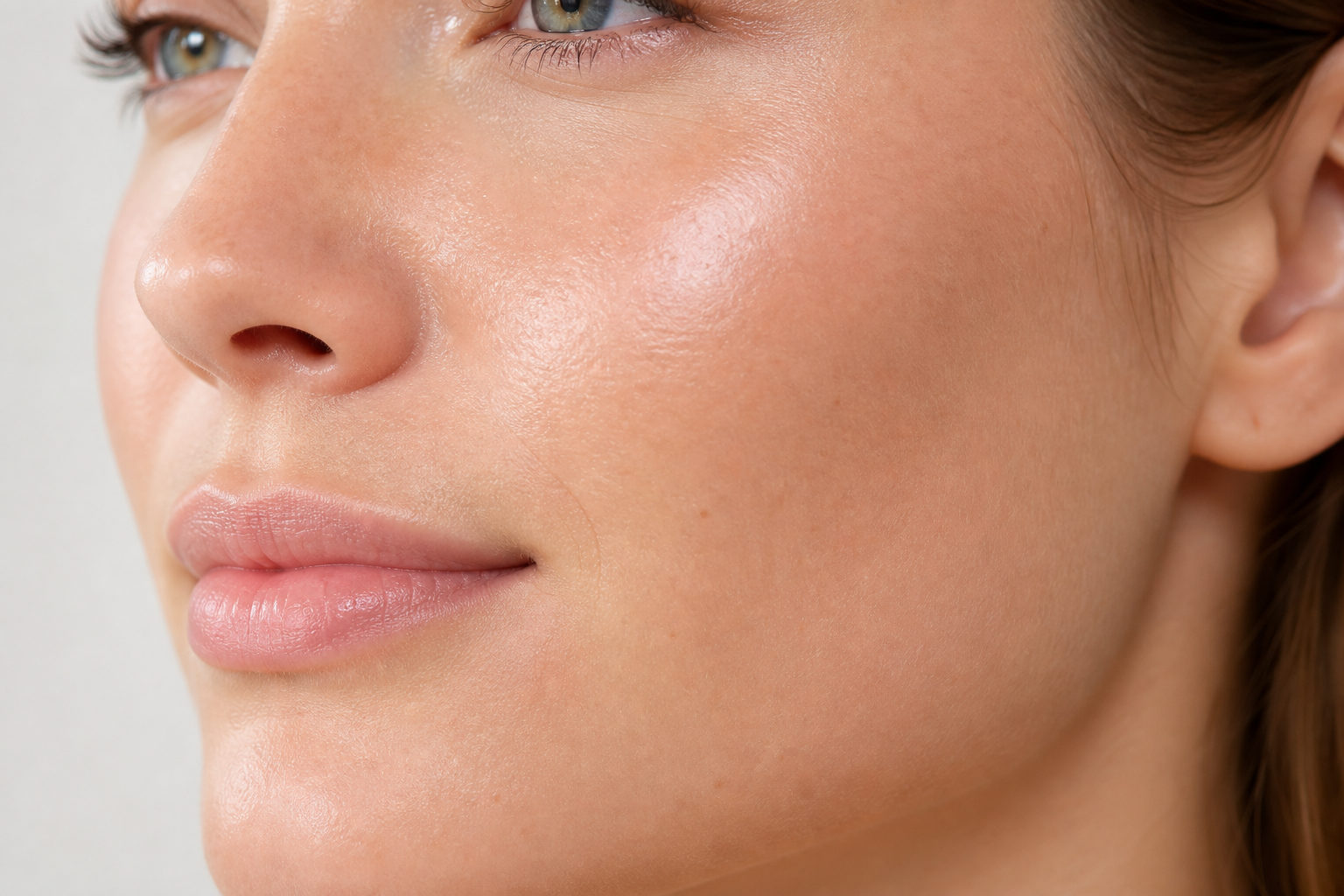
Skin looks noticeably smoother and brighter immediately after treatment.
Dermaplaning Cost in San Francisco
At Aesthetic OOGII, a standalone dermaplaning session is $275. That includes the full dermaplaning treatment plus a post-treatment serum and SPF application. Most Union Square studios charge between $100-150 for the same service, with luxury spas pushing $175-200. We keep our pricing straightforward with no hidden add-ons—the $275 gets you everything you need.
If you're planning to make dermaplaning part of your regular routine, we offer a 3-session package for $650, which works out to about $217 per session. That's a solid option if you want to maintain the results month over month without paying full price each time. Most people who try dermaplaning once end up booking it regularly, so the package saves you about $90 over six individual appointments.
Dermaplaning is often combined with other treatments to maximize results. A common pairing is dermaplaning + chemical peel, where the blade clears away dead skin first so the peel can penetrate deeper. That combo runs about $180-220 at most SF studios. Another popular add-on is dermaplaning + hydrating mask, which soothes your freshly exfoliated skin and locks in moisture—usually an extra $30-40 on top of the base dermaplaning price.
Some places bundle dermaplaning into signature facial packages. You'll see "luxury glow facials" for $250+ that include dermaplaning, extractions, LED light therapy, and high-end serums. Those can be worth it if you want the full spa experience, but if your main goal is exfoliation and hair removal, standalone dermaplaning delivers the core benefit at a fraction of the cost.
Dermaplaning vs. Other Exfoliation Treatments
Dermaplaning is one of several ways to exfoliate your skin, and each method has different strengths. Chemical peels use acids to dissolve dead skin cells and stimulate cell turnover. They're better for treating deeper concerns like hyperpigmentation, acne scars, and fine lines, but they come with more downtime—peeling, redness, and sensitivity for 3-7 days. Dermaplaning has zero downtime and gives you instant smoothness, but it only works on the surface layer.
Microdermabrasion uses a machine to spray fine crystals across your skin or a diamond-tipped wand to buff away dead cells. It's similar to dermaplaning in that it's mechanical exfoliation, but microdermabrasion can be harsher and isn't as precise. Dermaplaning also removes vellus hair, which microdermabrasion doesn't touch. If you want both exfoliation and hair removal in one treatment, dermaplaning is the better pick.
Chemical exfoliants like glycolic acid and salicylic acid are common in at-home skincare. They're effective for ongoing maintenance, but they can irritate sensitive skin and take weeks to show results. Dermaplaning gives you immediate improvement without the stinging or redness that acids can cause. Many people use dermaplaning every 3-4 weeks and incorporate gentle chemical exfoliants in between sessions for continuous cell turnover.
Microneedling is a different category altogether—it creates controlled micro-injuries to stimulate collagen production. It's used for acne scars, wrinkles, and skin texture issues that dermaplaning can't address. Some practitioners combine dermaplaning with microneedling, doing the blade exfoliation first to remove dead skin so the needles can penetrate more effectively. That's a more advanced treatment with longer recovery time, typically reserved for people targeting specific skin damage.
Aftercare: How to Maintain Your Results
Your skin is more sensitive immediately after dermaplaning, so the first 48 hours require extra care. Skip active ingredients like retinol, AHAs, BHAs, and vitamin C for at least 2 days—your newly exfoliated skin can't handle that level of intensity right away. Stick to gentle, hydrating products: a mild cleanser, a soothing serum (hyaluronic acid or peptides work well), and a rich moisturizer to lock in hydration.
SPF is non-negotiable. Without the protective layer of dead skin, UV rays penetrate deeper and can cause hyperpigmentation or sun damage more easily. Use a broad-spectrum SPF 30 or higher every day, and reapply every 2 hours if you're outside. Avoid direct sun exposure during peak hours (10am-4pm) for the first week if possible.
Don't pick at your skin if you experience minor breakouts or dry patches post-treatment. Some purging is normal—dermaplaning can bring clogged pores to the surface. Let them resolve on their own or use a gentle spot treatment. Picking will cause scarring and undo the smoothness you just paid for.
Hold off on other intensive treatments for at least a week. No laser procedures, chemical peels, or waxing until your skin has fully recovered. If you want to combine dermaplaning with another treatment like a HydraFacial or LED therapy, do them in the same session or wait 7-10 days between appointments.
Schedule your next session 3-4 weeks out if you want to maintain the results. That timing matches your skin's natural cell turnover cycle, so you're always keeping dead skin and peach fuzz at bay before they accumulate enough to make your skin look dull again.
Frequently Asked Questions
Will the hair grow back thicker or darker after dermaplaning?
No. This is one of the most common myths about dermaplaning, but it's not true. The treatment only removes vellus hair at the surface level—it doesn't affect the hair follicle or change the hair's structure. When it grows back, it returns at the same thickness, color, and rate as before. The myth likely started because people aren't used to feeling stubble on their face, but that's just the blunt edge of cut hair, not thicker regrowth.
Does dermaplaning hurt?
Not if it's done correctly. You'll feel a light scraping sensation and maybe some tugging as the blade moves across your skin, but it shouldn't be painful. If you feel sharp pain or see bleeding, that's a sign the esthetician is applying too much pressure or using the wrong angle. Speak up immediately if anything hurts—a skilled practitioner will adjust their technique. Most people find the treatment relaxing, similar to getting a facial.
Can I dermaplane at home with those razors I see online?
You can buy at-home dermaplaning tools, but they're not the same as professional-grade scalpels. Drugstore dermaplaning razors have guards and duller blades, so they're safer for DIY use but less effective. You won't get the same level of exfoliation, and if you use the wrong angle or too much pressure, you risk nicks, cuts, or uneven results. Professional dermaplaning is done by licensed estheticians trained in blade technique—they know how to hold the skin taut and control the blade for consistent, safe results. If you want to maintain between sessions, at-home tools are fine for touch-ups, but they won't replace a professional treatment.
How soon can I wear makeup after dermaplaning?
You can apply makeup immediately after treatment if needed, though it's better to let your skin breathe for a few hours if possible. Your skin will be slightly pink and sensitive, and piling on foundation right away could clog your newly opened pores. If you do wear makeup the same day, use a clean brush or sponge and avoid heavy, pore-clogging formulas. Most people find their makeup looks better the next day anyway, once the pinkness fades and their skin has settled.
Is dermaplaning safe for all skin types?
Dermaplaning works well for most skin types, especially dry, dull, or mature skin. It's also safe for sensitive skin that can't tolerate chemical exfoliants. However, it's not recommended if you have active acne, especially inflammatory or cystic breakouts—the blade can spread bacteria and make acne worse. People with very thin skin, active rosacea, or eczema should also skip it, since the physical exfoliation can trigger flare-ups. If you're unsure, book a consultation first to let the esthetician assess your skin.
Dermaplaning: Quick Reference Facts
Dermaplaning is manual exfoliation with a surgical scalpel that removes dead skin and peach fuzz in one 30-45 minute session, no downtime required. Here are the specifics people ask about most.
- Best for: dull, textured skin; people who can't tolerate chemical exfoliants; pregnant or breastfeeding clients who need a non-chemical option.
- Not recommended for: active inflamed acne, rosacea flares, or open cold sores.
- Session length: 30-45 minutes for the full face.
- Cost in San Francisco: $275 at Aesthetic OOGII; $100-150 at most Union Square studios, up to $175-200 at luxury spas.
- Results last: 2-3 weeks before skin starts to look duller again.
- Recommended frequency: every 3-4 weeks, matching the skin's natural 28-day cell turnover cycle.
One myth worth clearing up directly: dermaplaning does not make hair grow back thicker or darker. It cuts vellus hair at the surface without touching the follicle, so regrowth returns at the same rate and texture. Pair it with a HydraFacial or book through our treatment menu if you want deeper hydration alongside the exfoliation.