
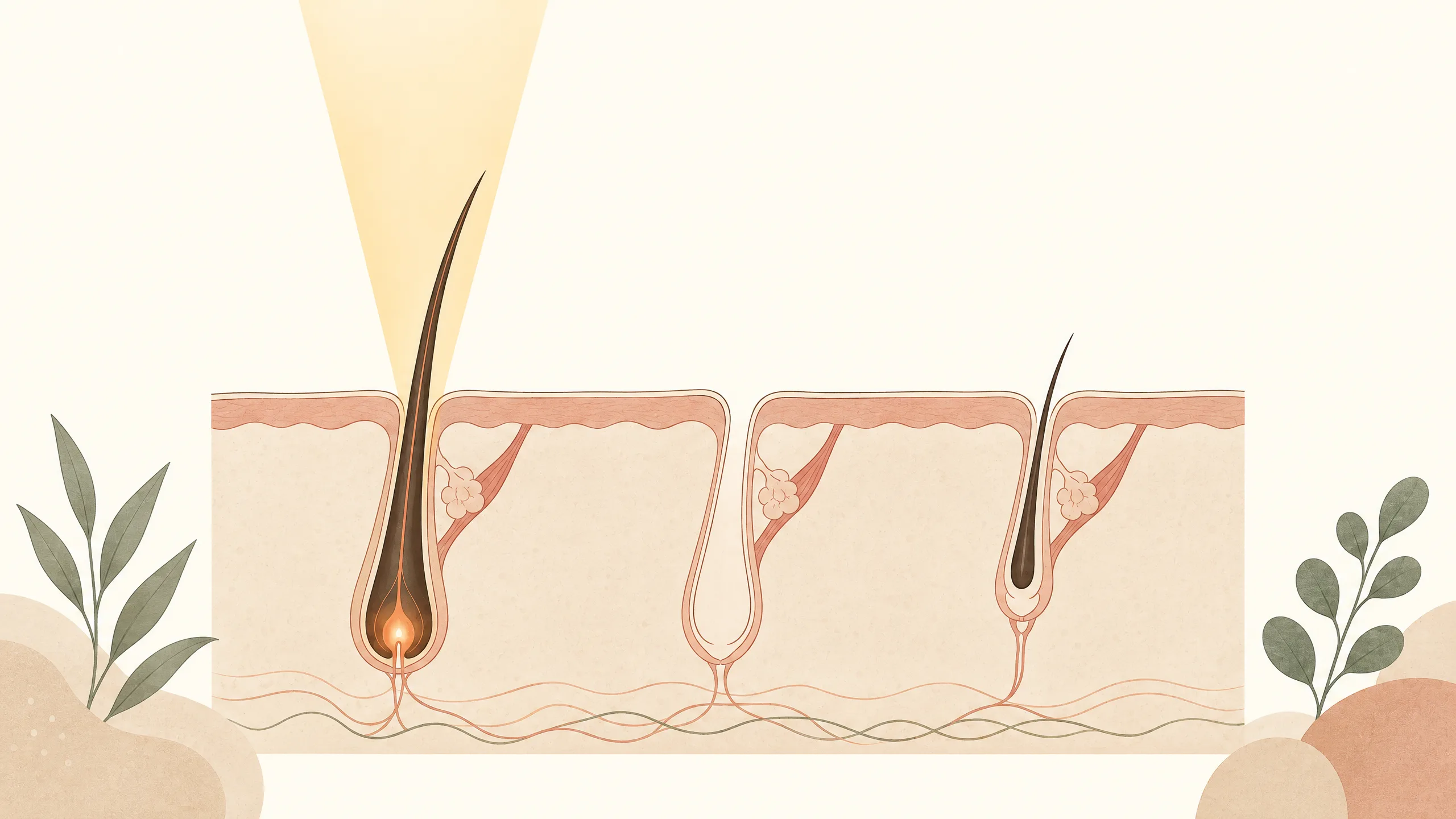


How it works
The American Academy of Dermatology explains that the laser emits a beam of light which the pigment (color) in your hair absorbs. Cleveland Clinic adds that a hair follicle has to be in its anagen, or growth, stage for the procedure to work, and that it is unlikely any one treatment reaches all the hairs in that phase. That is why it is booked as a series rather than a single visit.
Because the light is aimed at pigment, the AAD says laser hair removal works best for people with light-colored skin and dark-colored hair, and that it won't work on blonde, white, gray or red hair, because lasers cannot effectively target light-colored hair.
Areas treated and what each costs
| Area | Session length | Single session | Package |
|---|---|---|---|
| Chin and lip | 15 minutes | $110 | 5 sessions for $450 |
| Underarms | 30 minutes | $140 | 10 sessions for $1,275 |
| Bikini | 30 minutes | $200 | 10 sessions for $1,500 |
| Legs | 30 minutes | $225 | 10 sessions for $1,600 |
- Chin and lip — $110, 15 minutes. Five-session package $450, which saves $100 against five single sessions.
- Underarms — $140, 30 minutes. Ten-session package $1,275, which saves $125 against ten single sessions.
- Bikini — $200, 30 minutes. Ten-session package $1,500.
- Legs — $225, 30 minutes. Ten-session package $1,600.
Package sizes are pricing options, not a forecast of how many sessions your hair will need. Studio policy is that packages are non-refundable and must be redeemed within a calendar year. Current pricing is on the treatment menu.
How many sessions, and what results look like
There is no single number that fits everyone. The AAD's guidance is that you can expect a 10% to 25% reduction in hair after the first treatment, that most patients need two to six laser treatments to remove the hair, and that most can be treated once every four to six weeks; Cleveland Clinic describes sessions as usually about six to eight weeks apart. The person treating you decides the spacing for your skin and hair.
The AAD notes that results vary from patient to patient: the color and thickness of your hair, the area treated, the type of laser used and the color of your skin all affect them. After finishing treatment, most patients do not see hair on the treated skin for months or even years, and when hair regrows there tends to be less of it, finer and lighter in color. Most patients see some regrowth, and maintenance treatments may be needed to keep an area clear.
Facial hair on women is a special case. The AAD states that after six or more treatments laser hair removal is permanent except on a woman's face — so for chin and lip, plan on the possibility of maintenance sessions. If facial hair is increasing because of a hormonal condition, our guide to laser hair removal for chin hair in women covers why a doctor should be part of the plan.
What a session feels like
The AAD describes what happens: the area is cleansed, everyone in the room wears protective eyewear, the skin is held taut and treated with the laser. Many patients say the pulses feel like warm pinpricks or a rubber band being snapped against the skin; Cleveland Clinic describes it as a series of stings. Treating the upper lip takes minutes.
Afterward you will see some redness and swelling, which the AAD says often looks like a mild sunburn; a cool compress can help. Laser hair removal generally does not require real downtime, and most people return to their everyday activities.
Hair color and skin tone
The AAD notes that in the past only people with dark hair and light skin could safely have laser hair removal, and that today it is a treatment option for people with dark skin as well — but it must be performed very carefully, and the person treating you should have experience with your skin tone. Burns, permanent changes to skin color and scars can occur in inexperienced hands. Tell the studio about your skin tone and any history of pigment changes when you book, and ask about it at your consultation; the AAD suggests asking how many treatments the provider has performed on people with your skin coloring.
For blonde, white, gray or red hair, the AAD lists electrolysis — which sends an electrical current through the follicle — as a method that can permanently remove unwanted hair.
Before and after your session
The AAD's preparation guidance: do not tan, outdoors or indoors; do not use sunless tanners; and apply a broad-spectrum, water-resistant SPF 30+ sunscreen every day before going outdoors. Cleveland Clinic advises staying out of the sun as much as possible in the weeks before treatment, because tanned skin can make the treatment less effective and lead to side effects. It also advises that once treatment begins you avoid waxing, tweezing and plucking in the treated areas, since those remove the hair the laser needs to target. Ask the studio when to shave the area before your appointment.
After a session, the AAD advises keeping direct sunlight off treated skin, avoiding tanning beds and sun lamps, and following your provider's aftercare instructions. The most common side effects — discomfort, swelling and redness — are minor and last one to three days. Blistering, cold sore outbreaks, infection, scarring and skin lightening or darkening are rarer; contact the studio if you notice any of them.
Laser compared with shaving, waxing and threading
Shaving, waxing and threading are temporary. The AAD notes that shaving results are short-lived, frequent shaving can irritate the skin, and some people who shave develop ingrown hairs. Waxing and threading pull hairs out and have to be repeated as hair grows back. Among these methods, laser is the one that reduces regrowth over time; Cleveland Clinic says its results last longer than shaving, waxing, tweezing or plucking. Electrolysis is the other long-term option.
Because it reduces the hair that is shaved, laser may reduce shaving-related ingrown hairs — the AAD notes that men with constant razor burn or ingrown hairs from shaving can permanently remove their beard with it — but it is not a guarantee against every ingrown hair. What it cannot give is an instant result.
Who should wait or check first
Cleveland Clinic says you may need to avoid the procedure if you are pregnant, are taking certain medications such as acne treatments, have genital herpes or are prone to cold sores, have keloid scars, or have or have had skin cancer. The AAD asks you to tell your provider about a tendency to scar, a recent tan, any keloid, cold sore or genital herpes outbreaks, and whether you have taken isotretinoin or any other medicine, including non-prescription ones such as aspirin. The studio's policy likewise asks every client to tell it at booking about health conditions, allergies, injuries or recent medical procedures that may affect a service.
Booking and where to find us
Aesthetic OOGII is at 450 Sutter St #1530 in Union Square, San Francisco. Oogii is a certified medical and clinical aesthetician, and every client is offered a complimentary consultation that includes an assessment of your skin. Book any area or package from the online menu, or call +1-415-757-0265. The studio asks for 24 hours' notice to cancel or reschedule.