
Chin & Lip Laser Hair Removal: Cost, Sessions, Results
How many sessions, pain level, cost in San Francisco, and long-term results compared to waxing and threading.
How Laser Hair Removal Works on the Chin and Upper Lip
Laser hair removal targets the pigment (melanin) in your hair follicles with light energy. The melanin absorbs the light, heats up, and damages the follicle's ability to produce new hair. Unlike shaving (which only removes hair at the surface) or waxing (which pulls the hair out but doesn't destroy the follicle), the treatment disables the root structure so hair grows back finer, sparser, and eventually stops growing altogether.
The chin and upper lip are ideal areas for laser hair removal because:
- The skin is relatively flat and easy to treat consistently
- The hair tends to be dark and coarse — exactly what laser technology works best on
- Treatment sessions are quick (10-20 minutes for both areas combined)
- Results are highly visible since facial hair is so noticeable
The darker and coarser your hair, the more melanin it contains, and the better the treatment can target it. If you've got thick, visible facial hair that grows back within a day or two of shaving, you're a perfect candidate.
Here's what happens during a session: Your provider will clean the treatment area and may apply a numbing gel if you're sensitive to discomfort. They'll adjust the laser settings based on your skin tone and hair color — darker skin requires lower energy settings to avoid burns, while lighter skin can tolerate higher settings for faster results. You'll wear protective eyewear, then the technician will pass the laser handpiece over your chin and upper lip in small sections. Each pulse feels like a quick snap of a rubber band against your skin, followed by a warm sensation.
The entire treatment takes 10-20 minutes for both areas combined. Afterward, your skin will be pink and slightly swollen for a few hours (it looks like mild razor burn). You can apply ice packs and aloe gel to soothe the irritation. Most people go back to work or normal activities immediately — there's no downtime, though you'll want to skip makeup for the rest of the day to let your skin breathe.
One important point: laser hair removal only works on hair that's actively growing (the anagen phase). At any given time, only 20-30% of your facial hair is in this phase, which is why you need multiple sessions spaced 4-6 weeks apart to catch all the follicles as they cycle into the growth phase. This isn't a one-and-done treatment — plan on 6-8 sessions for permanent reduction, with possible touch-ups once or twice a year afterward.
How Many Sessions You'll Need for Permanent Results
Most people need 6-8 sessions to achieve significant, lasting hair reduction on the chin and upper lip. Some see significant results after 4 sessions, while others with hormonal imbalances (PCOS, thyroid issues) may need 10-12 sessions plus ongoing maintenance. The number depends on:
- Your hair growth cycle and how many follicles are active at once
- Hormonal factors (PCOS, thyroid conditions, menopause)
- How your skin responds to the laser energy level
- Consistency with your 4-6 week treatment schedule
Sessions are spaced 4-6 weeks apart for facial hair because that's how long it takes for dormant follicles to enter the active growth phase. If you space treatments too close together (every 2-3 weeks), you're wasting money treating hair that isn't ready yet. If you wait too long between sessions (8+ weeks), you'll lose momentum and extend your overall timeline. Stick to the 4-6 week schedule your provider recommends — it's based on facial hair biology, not arbitrary timing.
Here's what to expect after each session: Within 7-14 days, the treated hairs will start to shed. They'll look like they're growing, but if you tug gently, they'll slide out with no resistance — that's the damaged hair being pushed out by your skin. After that shedding period, you'll have 2-3 weeks of smooth, hair-free skin before the next cycle of follicles starts growing. With each treatment, the regrowth comes in thinner, lighter, and slower.
By session 4, most people notice they're shaving or plucking half as often as before treatment. By session 6, you're down to occasional fine hairs rather than the thick, coarse growth you started with. By session 8, you're looking at a significant, lasting reduction, meaning the majority of follicles produce little or no hair and you only have scattered strays to deal with.
That said, laser hair removal isn't 100% permanent for everyone. Hormonal fluctuations (pregnancy, menopause, thyroid changes, PCOS flare-ups) can reactivate dormant follicles years after treatment. If you have a hormonal condition that drives excessive facial hair growth, you'll likely need annual touch-up sessions to maintain results. If your facial hair is purely genetic (not hormone-driven), your results will be more permanent with minimal maintenance.
One mistake people make: stopping treatment after 3-4 sessions because they're happy with the results. You'll get some reduction early on, but if you don't complete the full series, those remaining follicles will keep cycling and you'll end up with patchy regrowth within a few months. Finish all 6-8 sessions even if you're seeing improvement early — that's how you lock in permanent reduction rather than temporary thinning.
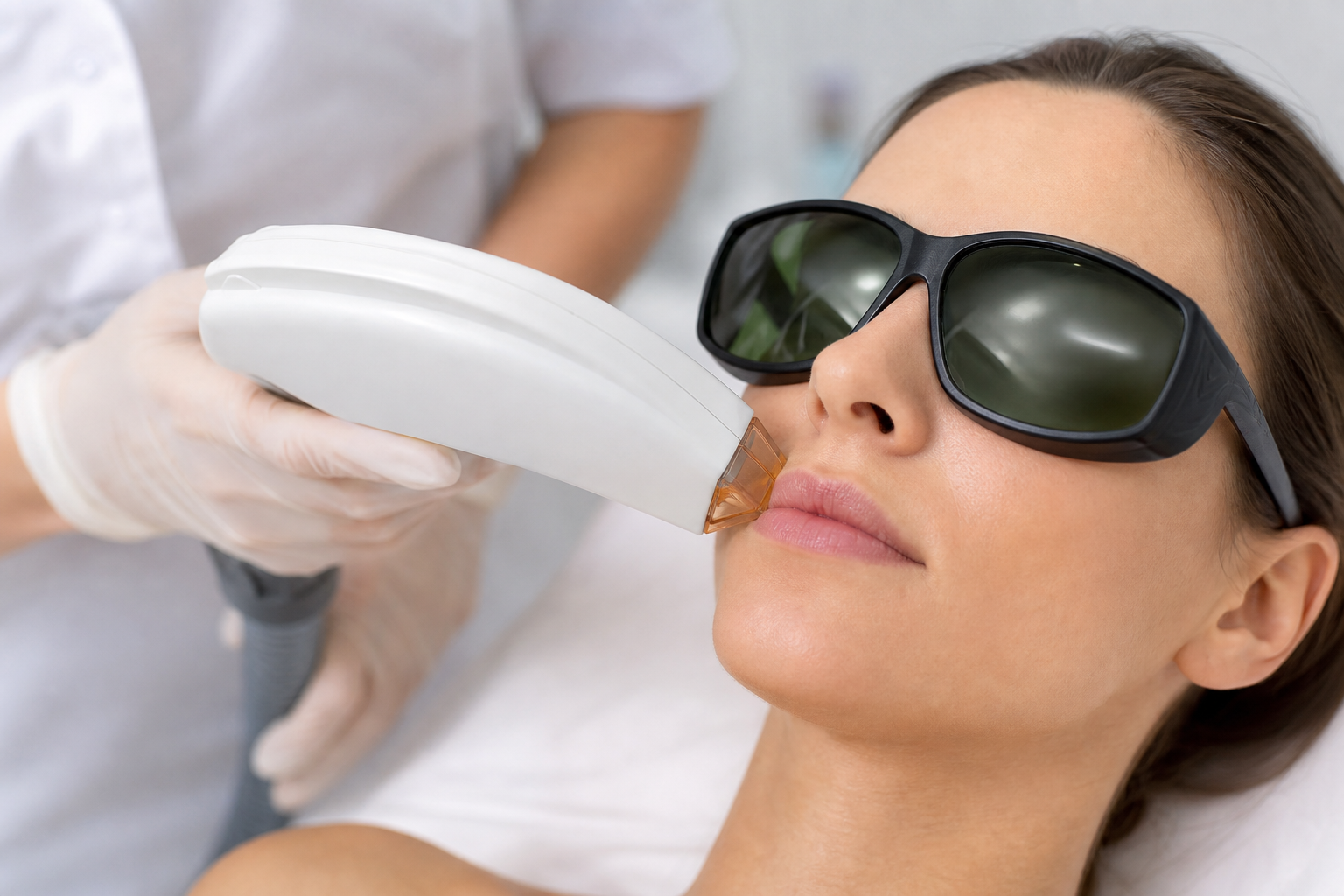
Laser hair removal sessions for the upper lip and chin take just 10-20 minutes with minimal discomfort.
What Laser Hair Removal Feels Like: Pain and Discomfort
The most common question people ask before their first session: does it hurt? The honest answer is yes, it's uncomfortable — but it's not unbearable, and it's over quickly. Most people describe the sensation as a rubber band snapping against your skin repeatedly, followed by a warm, stinging feeling that fades within seconds. The upper lip tends to hurt more than the chin because the skin is thinner and more sensitive, but we're talking about 2-3 minutes of discomfort, not prolonged pain.
Your pain tolerance matters. If you wax regularly, laser hair removal will feel similar — maybe slightly more intense per pulse, but much faster overall since the laser treats multiple follicles at once. If you've never waxed and you're sensitive to pain, the first session might be rough. The good news: it gets easier with each treatment because there's less hair to target, which means fewer pulses and less sensation.
Most clinics offer numbing options if you're worried about pain:
- Topical numbing cream (lidocaine) applied 20-30 minutes before treatment
- Cooling devices built into the laser handpiece that blow cold air between pulses
- Ice packs immediately before and after treatment
Don't feel embarrassed to ask for numbing — facial skin is sensitive, and there's no prize for toughing it out.
One thing that affects pain level: your menstrual cycle. Many people report that laser treatments hurt more during the week before their period when skin sensitivity is higher. If possible, schedule your appointments during the first two weeks of your cycle when pain tolerance is better. Also avoid caffeine and alcohol on treatment day — both can increase skin sensitivity and make the zaps feel sharper.
After the session, your skin will feel warm and tender for a few hours, like a mild sunburn. Applying aloe gel or a cool compress helps. Avoid hot showers, saunas, and intense exercise for 24 hours because heat will aggravate the irritation. Most people take ibuprofen if the soreness bothers them, but it's usually mild enough that you won't need it.
Compared to waxing or threading (which you have to do every 2-4 weeks forever), laser hair removal is a short-term discomfort for long-term payoff. Six sessions of 10 minutes each over six months is about one hour of total discomfort in exchange for years of smooth, hair-free skin. Most people agree it's worth it.
Cost of Chin and Lip Laser Hair Removal in San Francisco
At Aesthetic OOGII, laser hair removal for the chin and upper lip together costs $110 per session. That's middle-range pricing for Union Square — some clinics charge as low as $80-100 per area (so $160-200 for both), while high-end med spas push $150-200 per session for each area. We keep the cost straightforward with no hidden fees — the $120 includes both areas in one appointment.
If you're planning to complete a full treatment series, we offer package pricing that brings the per-session cost down:
- 5-session package: $450 (works out to $90 per session, saves you $100)
Most people need 6-8 sessions for permanent reduction, so a package makes sense financially. Paying per session is fine if you want to test it first, but once you commit to the full series, the package saves you the equivalent of 1-2 free sessions.
Compared to the lifetime cost of waxing, laser hair removal pays for itself within 2-3 years. If you wax your chin and upper lip every 4 weeks at $30-50 per appointment, you're spending $360-600 per year — forever. After 6-8 laser sessions (total cost $720-960), you're done except for occasional touch-ups. Over 10 years, waxing costs $3,600-6,000 while laser costs under $1,200 including maintenance. The math is clear.
One cost factor to consider: your skin and hair type. People with dark hair and light skin respond fastest to laser treatment and usually stay within the 6-8 session range. People with darker skin or lighter hair may need 10-12 sessions because the laser has to work harder to target the follicles without damaging surrounding skin. That can push the total cost to $1,000-1,200, but it's still cheaper than years of waxing.
Insurance doesn't cover laser hair removal for cosmetic purposes. If you have a documented medical condition like PCOS or hirsutism (excessive hair growth) that's diagnosed and treated by a doctor, some plans may cover part of the cost — but you'll need a prescription and pre-authorization. Most people pay out of pocket. Some clinics offer financing through third-party payment plans (CareCredit, Cherry) if you want to spread the cost over several months.

After 6-8 sessions, most clients achieve significant, lasting hair reduction on the chin and upper lip.
Laser vs. Waxing, Threading, and Shaving
Each hair removal method has trade-offs. Shaving is the cheapest and fastest option, but you're dealing with stubble every 1-2 days, plus the risk of razor burn, ingrown hairs, and that visible shadow where the hair is cut at the surface. It's a daily maintenance task that never ends.
Waxing and threading remove hair from the root, so you get 2-4 weeks of smoothness before regrowth. The downsides:
- Pain — waxing rips hair out in one go, threading plucks individual hairs (both hurt more than laser)
- Ongoing cost — $30-50 every 3-4 weeks adds up to $360-600/year forever
- Ingrown hairs and skin irritation, especially on sensitive facial areas
- You have to let hair grow out between appointments (no smooth period right before your session)
Waxing and threading are temporary solutions. You're paying and enduring pain indefinitely with no progress toward permanent reduction.
Laser hair removal is the only method that actually reduces hair growth over time by disabling the follicles. After 6-8 sessions, you're looking at significant, lasting reduction. The hair that does grow back is finer, lighter, and slower. Most people only need annual touch-ups after completing their initial series. The upfront time and cost investment pays off with years of low-maintenance, smooth skin.
The other benefit: laser hair removal eliminates the ingrown hair problem. When hair is repeatedly ripped out (waxing/threading) or cut at the surface (shaving), it can grow back into the skin and cause painful, inflamed bumps. Laser-treated follicles either stop producing hair or produce much finer hair that doesn't curl back into the skin.
One thing laser can't do: give you instant results. You're committing to 6-8 sessions over 6-8 months before you see the full benefit. Waxing and threading give you smooth skin immediately (though with pain and regrowth). If you need hair gone for an event next week, laser isn't the answer. But if you're tired of the wax-shave-pluck cycle and want a long-term fix, laser is the clear winner.
Who Should Avoid Laser Hair Removal
Laser hair removal isn't safe for everyone. Here's who should skip it or wait:
- Pregnant or breastfeeding: There's no solid research on laser safety during pregnancy, so most providers won't treat you. Wait until after you've finished breastfeeding.
- Active skin infections or cold sores: Laser can spread infections and make outbreaks worse. If you get frequent cold sores around your mouth, your provider may prescribe antiviral medication to take before sessions.
- Recent sun exposure or tanning: Tanned or sunburned skin has more melanin, which increases the risk of burns and hyperpigmentation. Wait 4-6 weeks after sun exposure before getting laser treatment, and avoid tanning throughout your treatment series.
- Certain medications: Antibiotics (tetracycline, doxycycline), acne medications (isotretinoin/Accutane), and some antidepressants make your skin more photosensitive. Tell your provider about all medications — you may need to pause treatment or adjust timing.
- Keloid scarring: If you're prone to keloids (thick, raised scars), laser treatment could trigger abnormal scarring on your face.
- Very light or gray hair: The treatment targets melanin, so if your facial hair is blonde, white, red, or gray, it won't respond well. Electrolysis is a better option for light hair.
If you have darker skin (Fitzpatrick types IV-VI), you need a provider experienced with darker skin tones, and whether the treatment is suitable comes down to the equipment and settings, which a consultation and patch test establish. Deeper skin tones carry a higher risk of hyperpigmentation or burns, so that assessment matters before you book a full course.
Aftercare: How to Care for Your Skin Between Sessions
Proper aftercare protects your skin and maximizes results. Here's what to do after each session:
First 24-48 hours:
- Avoid hot showers, saunas, steam rooms, and intense exercise — heat will irritate your skin
- Apply aloe vera gel or a cool compress to soothe redness and swelling
- Skip makeup if possible (at least for the first 24 hours)
- Don't pick at or scratch treated areas, even if they feel itchy
Throughout your treatment series:
- Wear SPF 30+ every day: Treated skin is more vulnerable to UV damage. Sun exposure can cause hyperpigmentation and make future sessions less effective.
- Don't wax, pluck, or thread between sessions: Laser targets the hair follicle, so if you pull hair out by the root, there's nothing for the laser to treat at your next appointment. Shaving is fine because it leaves the follicle intact.
- Exfoliate gently: 7-14 days after each session, you'll notice treated hairs shedding. Light exfoliation (a washcloth or gentle scrub) helps them come out. Don't force it — they'll shed on their own.
- Avoid harsh skincare products: Retinol, glycolic acid, and other strong actives can irritate your skin when it's healing from laser treatment. Stick to gentle cleansers and moisturizers for 3-4 days after each session.
If you notice prolonged redness (lasting more than 3 days), blistering, or unusual scarring, contact your provider immediately. Those are signs of a reaction that needs medical attention.
Frequently Asked Questions
Can I shave between laser hair removal sessions?
Yes, shaving is fine and actually recommended. The laser targets the hair follicle beneath your skin, not the visible hair on the surface, so shaving doesn't interfere with treatment. In fact, most providers ask you to shave 24 hours before your appointment so the laser energy goes into the follicle rather than getting absorbed by surface hair. Just don't wax, pluck, or thread — those methods remove the follicle, which means there's nothing for the laser to target.
Will laser hair removal work on my skin tone?
Skin tone affects both suitability and risk. Lighter skin with dark hair is the most straightforward to treat; deeper skin tones need conservative settings and carry a higher risk of burns or hyperpigmentation, so they are not always suitable. Whether your skin can be treated safely is exactly what a consultation and patch test are for — ask about it before booking a full course.
What if I have PCOS or hormonal imbalances?
Laser hair removal still works if you have PCOS or other hormonal conditions that cause excess facial hair, but you'll likely need more sessions (8-12 instead of 6-8) and ongoing maintenance. Hormones can reactivate dormant follicles even after successful treatment, so many people with PCOS schedule annual touch-ups to keep facial hair under control. It's still more effective and cost-efficient than waxing every month for life. Talk to your provider about realistic expectations based on your hormone levels.
How long do results last?
For most people, laser hair removal provides significant, lasting reduction after completing a full series. The treated follicles are disabled and won't produce hair again. However, hormonal changes (pregnancy, menopause, aging) can activate new follicles that weren't treated, so some people need touch-up sessions every 1-2 years to maintain results. If you don't have hormonal conditions driving hair growth, your results can last decades with minimal maintenance.
Can I get laser hair removal if I'm on my period?
Yes, but your skin may be more sensitive during your period, which can make the treatment more uncomfortable. If possible, schedule your appointments during the first half of your menstrual cycle when pain tolerance is higher. If your session falls during your period and you're worried about pain, ask your provider for topical numbing cream or take ibuprofen 30 minutes before the appointment.